
Out of Specification (OOS) in Pharmaceutical Industry
Definition · Causes · Investigation Flowchart · FDA Guidelines · Real Example · GMP Compliance
Table:
- What is OOS? — Definition : Out of Specification (OOS) in Pharmaceutical Industry
- Types of OOS Results
- OOS vs OOT vs OOE — Key Differences
- Common Causes of OOS Results
- OOS Investigation Flowchart (Phase I & II)
- Phase I — Laboratory Investigation
- Phase II — Full Scale Investigation
- Real-World OOS Example with Numbers
- Retesting & Resampling Rules
- OOS Documentation Requirements
- FDA Guidelines & Regulatory References
- India-Specific: Schedule M & CDSCO
- How to Prevent OOS Results
- Frequently Asked Questions
What is OOS? — Definition of Out of Specification (OOS) in Pharmaceutical Industry
- In the pharmaceutical industry, an Out of Specification (OOS) result is any laboratory test result that falls outside the acceptance criteria or specifications that have been established for a product, raw material, in-process material, or finished dosage form.
- FDA Definition (Guidance for Industry, 2006): “Out of Specification (OOS) results include all test results that fall outside the specifications or acceptance criteria established in drug applications, drug master files (DMFs), official compendia, or by the manufacturer.” This definition also covers all in-process laboratory tests outside established specifications.
- To put it simply — if your specification says an assay result must be between 98.0% and 102.0%, and your test returns a result of 96.5%, that is an OOS result. It does not matter whether the deviation is small or large — any result outside the written specification triggers a mandatory OOS investigation.
- OOS results are taken very seriously in pharma because they may indicate a problem with the manufacturing process, the testing method, the raw materials, or the equipment — any of which could directly impact patient safety.
Types of OOS Results
OOS results can occur at different stages of pharmaceutical manufacturing and testing:
| Type | When It Occurs | Example |
|---|---|---|
| Raw Material OOS | During incoming material testing before use in manufacturing | API purity test returns 97.5% against spec of 99.0–101.0% |
| In-Process OOS | During intermediate stages of manufacturing | Blend uniformity fails during tablet granulation |
| Finished Product OOS | During final release testing of the finished dosage form | Dissolution result of 65% against spec of NLT 80% at 45 min |
| Stability OOS | During scheduled stability studies of the product | Assay drops to 93% at 18-month timepoint against spec of NLT 95% |
| Retained Sample OOS | During testing of retained/reserve samples | Reserve sample fails impurity test during annual review |
OOS vs OOT vs OOE — Key Differences
These three terms are frequently confused. Understanding the difference is critical for any pharma QA/QC professional:
🔴 OOS — Out of Specification
- Result falls outside written acceptance criteria
- Example: Assay 96.5% vs spec 98–102%
- Mandatory investigation required
- May result in batch rejection
- Triggered immediately on getting result
🟡 OOT — Out of Trend
- Result is within spec but shows unexpected trend
- Example: Assay trending from 101% → 100% → 99% → 98.5%
- Not a failure — but a warning signal
- Statistical monitoring required
- Proactive action prevents future OOS
🔵 OOE — Out of Expectation
- Result is unexpected compared to historical data
- Example: Sudden spike in one parameter with no process change
- Requires evaluation but less formal than OOS
- Not always linked to a specification
- Common in method validation & early development
Common Causes of Out of Specification (OOS) in Pharmaceutical Industry Results
OOS results can originate from two broad categories — laboratory errors and genuine product/process failures. Identifying which category applies is the entire purpose of the Phase I investigation.
| Category | Cause | Example |
|---|---|---|
| Laboratory Errors | Instrument malfunction or miscalibration | HPLC detector lamp failing; balance not calibrated |
| Analyst error / calculation mistake | Incorrect dilution factor used; transcription error | |
| Reagent / standard issues | Expired reference standard used; wrong potency applied | |
| Sample mishandling | Sample degraded due to incorrect storage before analysis | |
| Method not followed correctly | Wrong mobile phase pH; incorrect column used | |
| Genuine Failures | Raw material substandard | Supplier delivered low-purity API |
| Manufacturing process deviation | Mixing time reduced; wrong equipment used | |
| Equipment breakdown during production | Granulator malfunction causing non-uniform blend | |
| Environmental factors | Humidity spike degrading moisture-sensitive product | |
| Stability failure | Product stored outside label conditions during distribution |
OOS Investigation Flowchart — Phase I & Phase II
The following flowchart illustrates the complete OOS investigation process as per FDA Guidance for Industry (2006) – the globally accepted standard for pharmaceutical OOS handling:
Out of Specification (OOS) in Pharma -Investigation, Flowchart & FDA Guidelines
📊 OOS Investigation Flowchart — FDA Guidance Aligned
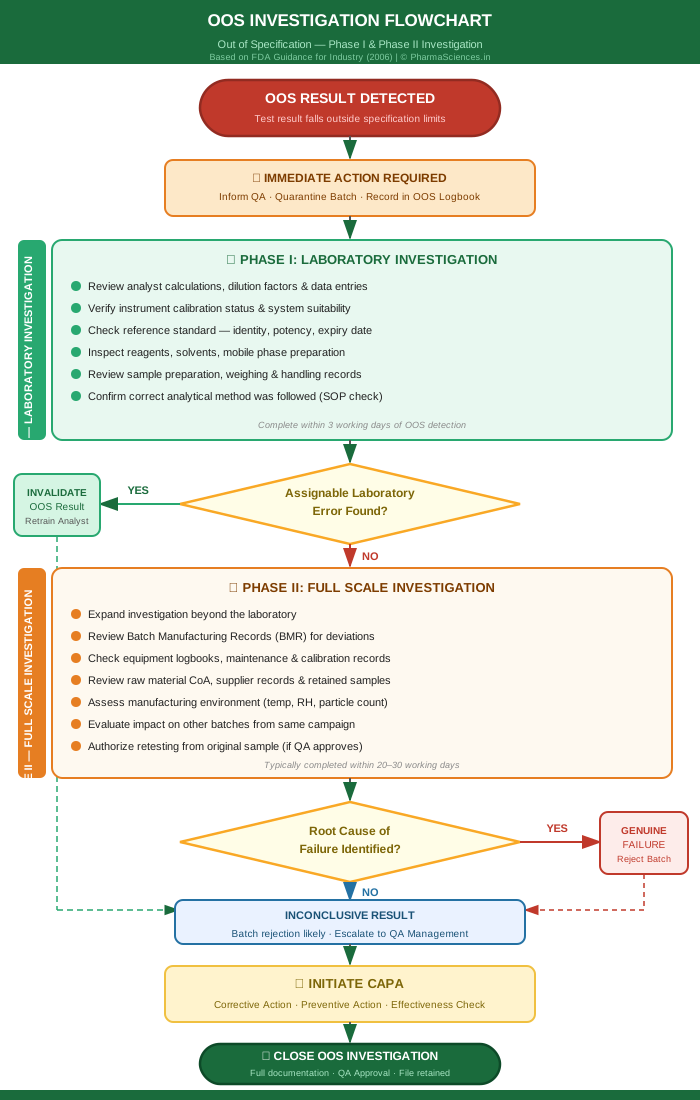
Based on FDA Guidance for Industry: Investigating OOS Test Results (2006)
© PharmaSciences.in | pharmasciences.in
Fig. 1: Complete OOS Investigation Flowchart — Phase I (Laboratory) → Phase II (Full Scale) → CAPA → Closure. Based on FDA Guidance for Industry (2006).
Phase I — Laboratory Investigation (Detailed)
- Phase I is always the first step. Its sole purpose is to determine whether the OOS result was caused by a laboratory error — before any conclusions are drawn about the product itself. This phase is entirely non-experimental at first (documentary review) and only becomes experimental if re-injection or re-preparation is warranted.
What to Check in Phase I
| Check Item | What to Verify | Common Error Found |
|---|---|---|
| Calculations | All manual and electronic calculations, dilution factors, potency corrections | Wrong dilution factor applied; potency of standard not accounted for |
| Instrument Status | Calibration due date, system suitability results, maintenance logbook | Balance overdue for calibration; HPLC detector showing drift |
| Reference Standard | Certificate of analysis, expiry date, storage conditions, potency value used | Expired standard used; wrong lot number referenced |
| Reagents & Solvents | Expiry, preparation date, storage, pH (if applicable) | Mobile phase prepared incorrectly; pH not adjusted |
| Sample Preparation | Weighing records, dissolution medium, sonication time, filtration | Sample weighed incorrectly; first few mL of filtrate not discarded |
| Method Compliance | Was the approved analytical method followed exactly? | Incorrect column used; wrong wavelength set on detector |
Phase II — Full Scale Investigation (Detailed)
- If Phase I cannot identify a laboratory error, Phase II begins. This is a broader investigation that goes beyond the laboratory and looks at the entire manufacturing process, raw materials, equipment, environment, and personnel involved in producing that specific batch.
Phase II Investigation Scope
| Area | What to Investigate |
|---|---|
| Batch Manufacturing Record (BMR) | Review all process steps, in-process results, operator signatures, deviations noted |
| Raw Materials | Re-test retained samples of the raw materials used; review supplier CoA and previous batch history |
| Equipment | Review equipment logbooks, cleaning records, preventive maintenance schedule, recent breakdowns |
| Environment | Review temperature, humidity, and particle count monitoring data from the manufacturing area on the date of production |
| Personnel | Were all operators trained and qualified? Were there any temporary or contract workers involved? |
| Utilities | Review water quality (purified water / WFI) records; compressed air quality records |
| Other Batches | Were other batches made on the same equipment, with the same materials, in the same period? Are they at risk? |
Real-World OOS Example with Numbers
📋 Case Study: Finished Product Assay OOS
Product: Metformin HCl Tablets 500mg
Test: Assay by HPLC
Specification: 95.0% – 105.0% of label claim
Result Obtained: 91.8% — OOS triggered
- Phase I Finding: Review of calculations revealed the analyst used the potency of the previous lot of working standard (99.4%) instead of the current lot (102.1%). When the correct potency was applied, the recalculated result was 101.2% — which passes the specification.
- Outcome: OOS invalidated due to assignable laboratory calculation error. Analyst retrained. CAPA raised for mandatory double-check of reference standard potency before each analysis.
📋 Case Study: Dissolution OOS — Genuine Failure
Product: Amlodipine Tablets 5mg
Test: Dissolution — USP Apparatus II, 900mL pH 6.8 buffer, 50 rpm, 30 min
Specification: NLT 80% (Q) at 30 minutes
Result Obtained: 71% — OOS triggered
- Phase I Finding: No laboratory error found. All instruments calibrated, standard prepared correctly, method followed as per SOP.
- Phase II Finding: BMR review revealed that the lubricant (Magnesium Stearate) was blended for 8 minutes instead of the approved 3 minutes. Over-lubrication caused hardening of the tablet surface, reducing disintegration and dissolution rate.
- Outcome: Genuine manufacturing deviation confirmed. Batch rejected. CAPA raised — revised SOP with mandatory timer for lubrication step. Blend time parameter locked in the process.
Retesting & Resampling Rules
One of the most misunderstood areas in OOS management is when retesting and resampling are permitted. The FDA guidance is very clear on this:
| Action | When Permitted | When NOT Permitted |
|---|---|---|
| Re-injection of original solution | Always permitted in Phase I to check instrument performance | Cannot replace the original OOS result without justification |
| Retest from original sample | Only when Phase I is inconclusive AND QA authorizes it | Cannot be done solely to obtain a passing result |
| Resampling | Only when Phase II investigation points to a sampling error | Cannot resample just because Phase I and Phase II found no cause |
| Averaging results | Only when pre-defined in the approved method or compendial method | Cannot average a failing and passing result to “pass” a batch — this is “testing into compliance” and is a major GMP violation |
Out of Specification (OOS) in Pharmaceutical Industry : Documentation Requirements
Every OOS investigation must be fully documented. Incomplete or vague documentation is itself a GMP violation. The OOS investigation report must include:
| # | Required Documentation Element |
|---|---|
| 1 | Clear description of the OOS result — product, batch, test, result obtained, specification |
| 2 | Date and time OOS was identified and reported to QA |
| 3 | Phase I investigation findings — all checks performed with results |
| 4 | Conclusion of Phase I — lab error confirmed/ruled out with specific evidence |
| 5 | Phase II investigation findings (if Phase I inconclusive) |
| 6 | Root cause — stated specifically, not vaguely |
| 7 | Impact assessment — other batches, retained samples, released product |
| 8 | Disposition decision — batch pass/reject with justification |
| 9 | CAPA actions raised with owner and due date |
| 10 | QA Manager review and approval signature with date |
FDA Guidelines & Regulatory References
Management of Out of Specification (OOS) in Pharmaceutical Industry is primarily governed by the following regulatory documents:
| Document | Issued By | Key Focus |
|---|---|---|
| Guidance for Industry: Investigating OOS Test Results for Pharmaceutical Production (2006) | US FDA / CDER | Primary guidance — defines OOS, investigation phases, retesting rules, documentation |
| 21 CFR 211.192 | US FDA | Requires thorough investigation of any unexplained discrepancy in test result |
| 21 CFR 211.194 | US FDA | Laboratory records must include complete data from all tests performed |
| ICH Q10 — Pharmaceutical Quality System | ICH | Requires systematic OOS management as part of the quality system |
| EU GMP Annex 11 | EMA | Data integrity requirements relevant to electronic OOS records |
| WHO Technical Report Series 929 (Annex 4) | WHO | WHO GMP guidelines covering OOS investigation requirements |
India-Specific: Schedule M & CDSCO Requirements
- For pharmaceutical manufacturers in India, OOS management requirements are governed primarily by Schedule M (Revised) of the Drugs and Cosmetics Act, 1940 — which is India’s equivalent of GMP regulations.
- Schedule M requires that all pharmaceutical manufacturers maintain a Quality Management System (QMS) that includes documented procedures for handling OOS results. The Central Drugs Standard Control Organisation (CDSCO) inspectors specifically look for OOS procedures, logbooks, and completed investigation reports during GMP audits.
- Key Schedule M requirements relevant to OOS include the requirement for written procedures for investigation of failures and deviations, retention of all OOS investigation records for a minimum period as specified, and mandatory CAPA with effectiveness checks for confirmed OOS events.
How to Prevent OOS Results
While OOS results can never be completely eliminated, a robust pharmaceutical quality system can dramatically reduce their frequency. Here are the most effective preventive measures:
| Area | Preventive Action |
|---|---|
| Analyst Training | Regular training on calculations, method execution, and data integrity. Competency assessments before independent testing. |
| Instrument Qualification | Maintain all instruments within calibration schedule. Perform IQ/OQ/PQ. Regular preventive maintenance. |
| Method Validation | Thoroughly validate analytical methods as per ICH Q2(R1). Ensure robustness testing covers real-world variability. |
| Reference Standard Management | Strict control of reference standards — proper storage, regular potency verification, expiry monitoring. |
| OOT Monitoring | Trend all QC data. Identify OOT results early and investigate before they become OOS events. |
| Supplier Quality | Qualify raw material suppliers rigorously. Conduct periodic audits. Review CoA against internal specifications. |
| Process Control | Monitor critical process parameters in real-time. Use statistical process control (SPC) where applicable. |
Frequently Asked Questions (FAQ)
- What is the first thing to do when an OOS result is obtained?
- The very first action is to notify the QA department and quarantine the batch or material involved. The result must be recorded in the OOS logbook immediately. Under no circumstances should the result be discarded, ignored, or retested without QA authorization. The FDA expects investigation to begin within one working day of OOS identification.
- Can an OOS result be invalidated?
- Yes — but only if Phase I investigation identifies a specific, documented, assignable laboratory error that was the cause of the OOS result. The error must be described with precision and supported by evidence. If no such error is found, the OOS result cannot be invalidated and Phase II must proceed.
- What is the difference between retesting and resampling in OOS?
- Retesting means testing additional portions of the same already-collected sample. Resampling means going back to the batch and collecting a new sample. Retesting may be authorized if Phase I is inconclusive and QA approves it with a scientific rationale. Resampling is only justified if the investigation points to a genuine sampling error — it cannot be done simply to get a passing result.
- How many retests are allowed for an OOS result?
- The FDA guidance does not define a specific number of retests. However, the number of retests must be pre-defined in the SOP before any retesting begins, be scientifically justified, and be authorized by QA. Any retesting plan that appears designed to generate passing results is considered “testing into compliance” — a serious GMP violation.
- What is “testing into compliance” and why is it prohibited?
- Testing into compliance refers to the practice of continuing to retest a sample until passing results are obtained, then using those passing results to release a batch — while ignoring the original OOS result. This is prohibited because it masks genuine product failures, compromises patient safety, and violates data integrity principles. It is one of the most common reasons pharmaceutical companies receive FDA warning letters.
- What is the regulatory reference for OOS investigation in India?
- In India, OOS investigation requirements are governed by Schedule M (Revised) of the Drugs and Cosmetics Act, 1940, enforced by CDSCO. For companies exporting to the US, the FDA Guidance for Industry: Investigating OOS Test Results for Pharmaceutical Production (2006) is the primary reference. WHO GMP guidelines (Technical Report Series 929, Annex 4) apply to WHO-GMP certified facilities.
Conclusion
- Out of Specification (OOS) in Pharmaceutical Industry results are one of the most critical events in pharmaceutical manufacturing. How a company handles an OOS result reveals the true maturity of its quality system — from the speed of response to the depth of investigation to the effectiveness of corrective actions.
- The key principles to always remember are: never ignore an OOS result, never retest without QA authorization, never average a failing result to achieve compliance, and always document every step of the investigation thoroughly. These principles, rooted in FDA guidance and ICH Q10, exist for one reason — to protect the patient who ultimately uses the product.
- If you found this article valuable, explore our other in-depth articles on CAPA, Deviation Management, and HPLC Method Validation on PharmaSciences.in. Have a specific pharma topic you want covered? Submit a request through our Ask a Question page.
Read More:
- Quality Assurance
- Common Pharma Interview Questions & Answers
- Good Chromatographic Practices (GCP)
- Good Documentation Practices (cGDP)
- Basic questions and answers about different Types of Chromatography
- ICH
- Calibration of HPLC
- Gas Chromatography Columns
- Why is 70% the More Effective Concentration of Isopropyl Alcohol for Disinfection?
- GAMP Guideline
- Acronyms and Abbreviations
- Alcohol Dose Dumping
- Documentation Practice (GDP) & ALCOA++
- Female Infertility