
Sterile Gowning Validation: In aseptic pharmaceutical manufacturing, personnel are the primary source of microbial and particulate contamination, generating over 75% of the cleanroom bioburden. A single unmoving cleanroom operator sheds roughly 100,000 particles per minute, making a flawless sterile gowning procedure the most critical defensive barrier for product sterility assurance.
This comprehensive compliance guide outlines the stringent regulatory frameworks of the USFDA and EU GMP, details step-by-step donning and removal workflows, highlights actual regulatory warning observations, and defines the lifecycle validation parameters required to establish an audit-ready cleanroom facility.
1. Regulatory Frameworks & Official Citations
Sterile gowning is not merely a localized site rule—it is a legally enforceable quality standard across global markets.
USFDA Regulatory Requirements
The U.S. Food and Drug Administration enforces personnel gowning standards through 21 CFR Part 211 (Current Good Manufacturing Practice for Finished Pharmaceuticals):
- 21 CFR § 211.28 (Personnel Apparel): Mandates that personnel must wear clean clothing appropriate for the duties they perform to protect drug products from contamination.
- 21 CFR § 211.113 (Control of Microbiological Contamination): Requires written, validated procedures designed to prevent objectionable microorganisms in sterile drug products.
- FDA Guidance for Industry (Aseptic Processing, 2004): Explicitly outlines expectations for complete body coverage, eliminating skin exposure in ISO 5 environments.
EU GMP & PIC/S Annex 1 Requirements
The updated EU GMP Annex 1 (Manufacture of Sterile Medicinal Products) significantly elevates the accountability metrics for gowning:
- Section 7 (Personnel – Paragraphs 7.11 to 7.17): Requires distinct gowning regimes scaled strictly by cleanroom tier (Grade A/B, C, or D).
- Paragraph 7.14: Bans outdoor clothing/socks from changing rooms leading directly into Grade B/C areas, requiring facility-dedicated undersuits and socks prior to entry.
- Paragraph 7.15: Demands that for Grade A/B zones, every single entry requires clean, sterile protective garments of an appropriate size, with eye coverings and masks.
2. Rationale: Why is Aseptic Gowning Required?
The overarching goal of sterile gowning is separating human bioburden from the critical product path. Gowning serves two fundamental functions:
- Contamination Barrier: Halts human skin flakes, hair, respiratory droplets, and microbial flora from contaminating sterile active substances, containers, and closures.
- Particulate Retention: Prevents non-viable macro-particles from altering the macro-environment of advanced isolators and Restrictive Access Barrier Systems (RABS).
3. Pre-Requisites & Post-Requisites
[Pre-Requisites: Hygiene & Prep] ──> [Aseptic Gowning Procedure] ──> [Post-Requisites: Post-Entry Verification]
Pre-Requisites (Before Gowning)
- Personal Hygiene: Strict adherence to cleanroom hygiene policies—no cosmetics, perfumes, hair spray, wristwatches, or body jewelry.
- Hand Hygiene: Thorough washing of hands and forearms for at least 30 seconds using an antimicrobial solution, followed by drying with HEPA-filtered air or lint-free sterile wipes.
- Dedicated Attire: Transit completely out of outdoor clothing into plant-managed, low-linting facility undergarments and facility socks.
Post-Requisites (After Gowning & Before Operation)
- Visual Verification: A full-body mirror check to confirm zero exposed skin or hair around the eyes, forehead, ears, or neck.
- Physical Integrity Inspection: Confirming absence of tears, compromised stitching, or faulty closures.
- Gloves Sanitisation: Thoroughly spray outer sterile gloves with Sterile 70% Isopropyl Alcohol (IPA) immediately before crossing into the Grade A/B operational envelope.
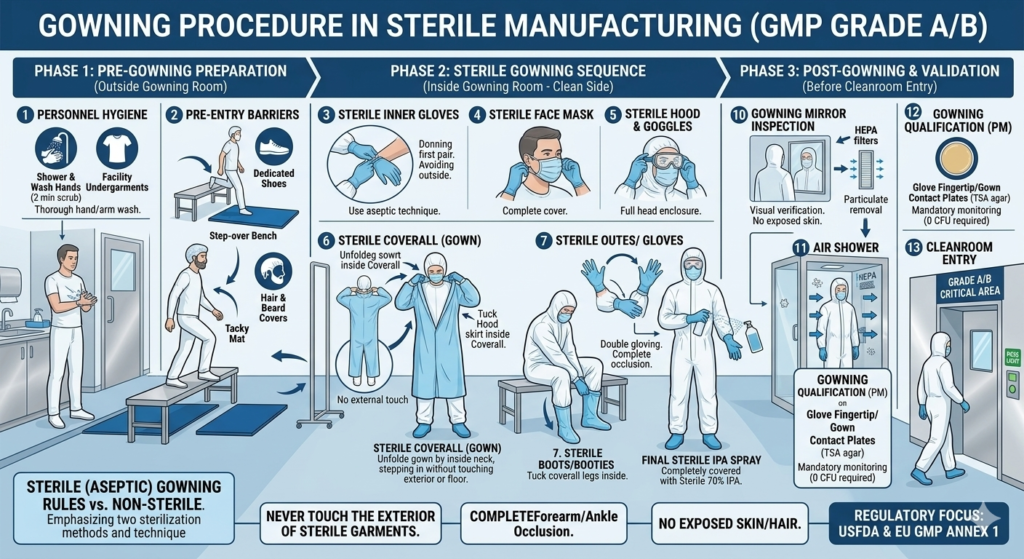
4. The Step-by-Step Sterile Gowning Procedure (Grade B Airlock) for Sterile Gowning
All donning steps must occur smoothly and deliberately to restrict air turbulence and particle generation.
- Inner Glove Donning: Disinfect bare hands with sterile alcohol; don the first (inner) pair of sterile gloves using an aseptic touchless technique.
- Face Mask Application: Fit the cleanroom face mask securely over the bridge of the nose and mouth to eliminate any side-gaps.
- Sterile Hood Integration: Don the sterile hood, ensuring it seals all hair and ears. Tuck the skirt component flat against the shoulders.
- Coverall Donning (Aseptic Unfurl): Carefully unpack the sterile coverall by holding only its inner collar. Slide into the legs and arms without letting the garment touch the floor, walls, or any non-sterile surfaces. Tuck the hood tail inside the zipped neck line.
- Booties & Step-Over Bench Transition: Sit on the step-over bench. Take the first sterile bootie, slide it over your foot, and tuck the coverall trouser leg inside. Swing that leg over to the “clean side” of the airlock. Repeat for the other leg.
- Sterile Goggles: Adjust sterile, anti-fogging cleanroom goggles snugly over the hood to close the ocular perimeter completely.
- Outer Glove Application: Don the second pair of sterile gloves, pulling the glove cuffs over the sleeves of the coverall to ensure complete forearm occlusion.
Sterile Gowning Procedure graphical presentation :
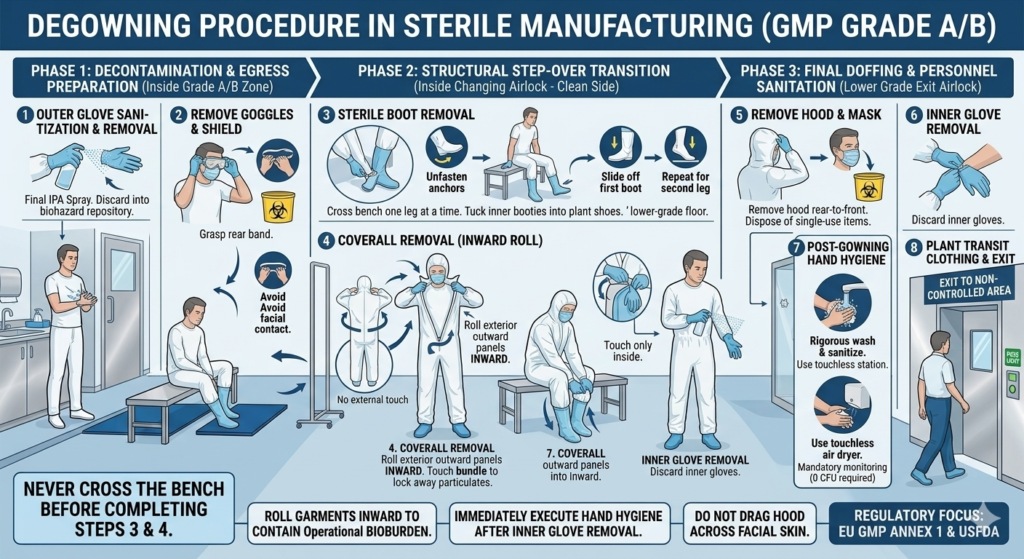
5. The De-Gowning (Removal) Procedure
De-gowning protects the external changeroom environment from accumulating operational bioburden and chemical residues.
- Step 1: Sanitize outer gloves with sterile IPA before moving to the degowning zone.
- Step 2: Remove outer gloves and discard them into designated biohazard bins.
- Step 3: Remove sterile goggles and place them into the designated reprocessing bin.
- Step 4: Unfasten and step out of the sterile boots one leg at a time while crossing back over the step-over bench to the lower-grade section.
- Step 5: Unzip and remove the coverall from the top down, folding it inward to handle only the interior fabrics.
- Step 6: Remove the hood, mask, and inner gloves. Peel inner gloves off inside-out to prevent skin-to-surface transfer.
- Step 7: Wash and sanitize hands thoroughly before exiting into non-controlled areas.
De-gowning (Doffing) Procedure in Sterile Manufacturing :
6. Real-World Regulatory Audit Observations (FDA 483 & EMA)
(Note: Just for Information only & Education purpose only)
Evaluating past regulatory failures highlights the areas auditors scrutinize during on-site inspections.
USFDA Form 483 & Warning Letter Examples related to Sterile Gowning Validation & procedure
- Exposed Facial Skin (Iso-Tex Diagnostics Warning Letter): Investigators observed production personnel with exposed facial skin and hair entering an ISO 5 production area while performing manual aseptic filling.
- Inadequate Gown Assembly (FDA 483 Citation): Gowning attire for ISO 5/7 entry left visible skin uncovered around the eyes, forehead, and neck of the operators. Gowns were also being improperly re-sterilized without validated parameters.
- Damaged Garments (AACE Warning Letter Trend): Inspectors discovered operators using ripped, frayed, and visibly dirty gowning in aseptic processing areas.
EMA Non-Compliance Database Trends for Sterile Gowning Validation
- Deficient Glove Cuff Management: European authorities have logged multiple non-compliance entries in the EudraGMDP Database due to operators leaving cuffs un-tucked or pulling exposed coverall sleeves over their outer gloves.
- Failure to Standardize Movements: Observations cited personnel moving rapidly inside Grade B changing areas, leading to high particulate alerts on environmental monitoring sensors.
7. Gowning Qualification: Regulatory Requirements & Frequency
An operator cannot step foot into an active Grade A/B operational filling line without an active, documented Gowning Qualification status.
The Qualification Protocol
- Theoretical Assessment: Comprehensive training in cleanroom microbiology, hygiene, and the physical aerodynamics of contamination.
- Practical Training & Observation: Multiple supervised walkthroughs in a mock changing room environment.
- Microbiological Validation: The operator gowns three consecutive times without error. After each gowning event, Quality Control conducts Personnel Monitoring (PM) using contact agar plates (e.g., Tryptic Soy Agar with neutralizers).
- Sampling Locations: Left/Right glove fingertips, forearms, chest, and hood.
- Acceptance Criteria: Zero Colony Forming Units (0 CFU) for Grade A/B zones.
Qualification Frequency Matrix
| Qualification Status | Frequency Rule | Regulatory Basis |
| Initial Qualification | 3 consecutive successful trials with 0 CFU recoveries. | EU GMP Annex 1 Para 7.4 |
| Routine Requalification | At least annually (Every 12 Months); many high-throughput sites require semi-annual (6 months) qualification. | FDA Aseptic Processing Guide / Annex 1 |
| Disqualification & Triggered Re-Evaluation | Triggered immediately upon a single failed routine PM sample, long absences from production, or inclusion in a failed Media Fill (Aseptic Process Simulation). | EU GMP Annex 1 Para 7.6 |
8. Strategic Integration into the Contamination Control Strategy (CCS) w.r.t Sterile Gowning Validation
Modern pharmaceutical regulation treats gowning as a dynamic node within a holistic Contamination Control Strategy (CCS) rather than an isolated silo.
- Lifecycle Lifecycle Assessment: Material performance profiles (e.g., single-use disposable garments vs. multi-use launderable suits) must undergo risk assessments regarding degradation over wash/sterilization cycles.
- Maximum Occupancy Thresholds: Gowning facilities must have clear limits on maximum concurrent personnel. This capacity must align with the environmental loads tested during formal Aseptic Process Simulations (APS / Media Fills).
- Actionable Personnel Monitoring Data: Periodic quality metrics from gown monitoring must be graphed and analyzed. Consistent microbial recoveries from a specific operator’s forearms or hood point to systemic behavioral errors, triggering mandatory retraining.
Read More:
- Quality Assurance
- Microbiology
- Sterile Gowning Validation
- Seasonal HVAC qualification cGMP
- Depyrogenation Methods in Pharmaceutical Manufacturing
- What is immunogenicity?
- What is SmPC? A Complete Guide for Regulatory Compliance (2025)
- Interchangeable Biosimilars vs Biosimilars vs Reference Biologics
- Depyrogenation in Pharmaceutical Manufacturing
- Pharmaceutical HVAC Validation Deviation & Troubleshooting Guide