
Monoclonal Antibody Production : Advanced Engineering Technologies in Pharma
Monoclonal antibodies (mAbs) are vital tools in modern biotherapeutics and diagnostics. Discover the three primary platforms driving their development: Hybridoma Technology, Phage Display, and Single B-Cell Isolation.
1. Hybridoma Technology in Monoclonal Antibody Production
The traditional standard for generating continuous cell lines capable of secreting highly specific monoclonal antibodies through cell fusion.
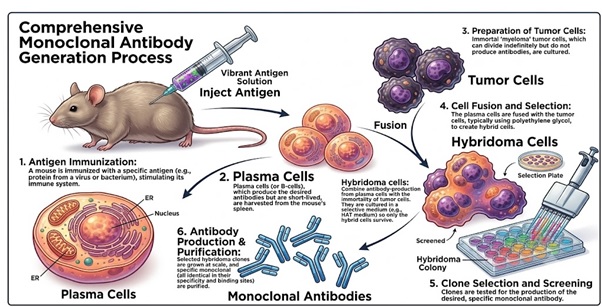
- Antigen Immunization: A host animal (typically a mouse) is injected with the target antigen to trigger an immune response, generating specific antibody-producing B-lymphocytes.
- Isolation of B Cells: The animal’s spleen is harvested to extract the mature, antigen-activated B cells.
- Cell Fusion: The isolated B cells are fused with immortalized myeloma (cancerous) cells using polyethylene glycol (PEG) or electrofusion, creating hybrid cell lines known as hybridomas.
- Screening & Selection: The hybrid cells are cultured in selective medium (like HAT medium). The surviving clones are screened to identify those producing the specific target antibody, followed by single-cell cloning for purity.
- Clonal Expansion: The selected, high-performing hybridoma clones are expanded in large-scale cell culture systems.
- Downstream Purification: The secreted monoclonal antibodies are harvested from the supernatant and purified via chromatography to achieve therapeutic-grade quality.
2. Phage Display Technology
An advanced, in vitro selection technique that uses filamentous bacteriophages to present functional antibody fragments on their coat proteins, linking genotype directly to phenotype.
The Step-by-Step Bioprocess
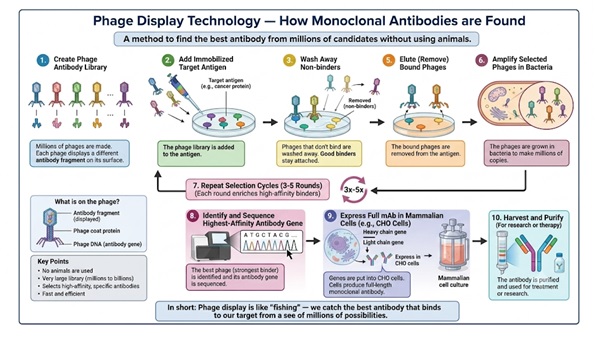
- Generate the Phage Library: Build a massive, diverse library containing millions to billions of genetically modified bacteriophages. Each phage is engineered to display a unique human antibody fragment (such as scFv or Fab) on its surface while carrying the corresponding genetic sequence inside its capsule.
- Immobilize the Target Antigen: Anchor the specific target antigen onto a solid surface, such as magnetic beads or the wells of a microtiter plate, to serve as structural bait.
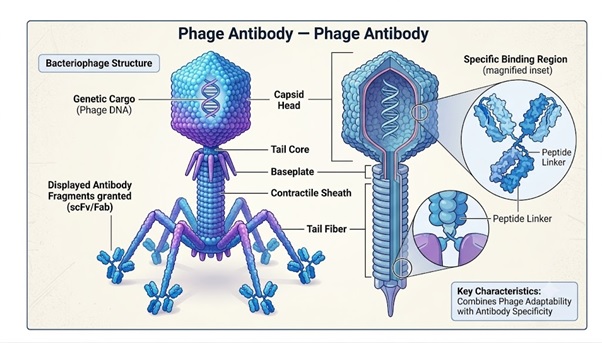
- Incubate Phages with Antigen: Introduce the diverse phage library to the immobilized antigen. Phages displaying fragments that naturally recognize the target will bind tightly, while non-specific phages remain free in suspension.
- Wash Away Non-Binders: Apply stringent buffer washes to rigorously remove weak or non-specifically bound phages, effectively eliminating background noise.
- Elute Bound Phages: Alter the chemical environment (e.g., lowering pH or adding competitive binders) to disrupt the antigen-antibody bond, recovering the high-affinity candidate phages.
- Amplify in E. coli: Infect host E. coli bacteria with the eluted phages. The bacteria serve as biological factories to rapidly replicate the selected phages into a concentrated pool.
- Iterate the Selection Cycle: Repeat steps 2 through 6 for 3 to 5 rounds. Increasing wash stringency in each successive round forces affinity maturation, ensuring only the strongest binders survive.
- Identify and Sequence: Isolate individual phage clones from the final pool. Extract and sequence their DNA to identify the exact genetic blueprint of the high-affinity antibody fragment.
- Express Full mAb in Mammalian Cells: Clone the identified binding sequences into expression vectors containing a full human antibody structural backbone. Transfect these into mammalian cell lines, such as Chinese Hamster Ovary (CHO) cells, to ensure proper protein folding, assembly, and human-like glycosylation patterns.
- Harvest and Purify: Collect the fully assembled monoclonal antibodies from the cell culture media and purify them using Protein A chromatography for downstream characterisation.
Strategic Advantages of Phage Display in Monoclonal Antibody Production
- Massive Screening Capacity: Screens billions of candidate molecules simultaneously to identify rare high-affinity binders.
- Completely Animal-Free: Eliminates ethical and biological concerns by conducting the entire selection process in vitro.
- High Specificity & Selection Pressure: Multi-round selection cycles selectively enrich only the strongest-binding antibody candidates.
- Streamlined Gene Identification: The physical link between the surface antibody fragment and the internal viral DNA makes sequencing immediate and straightforward.
3. Single B-Cell Technology
A high-throughput platform that isolates individual, native B-lymphocytes to directly capture natural antibody repertoires with preserved heavy- and light-chain pairings.
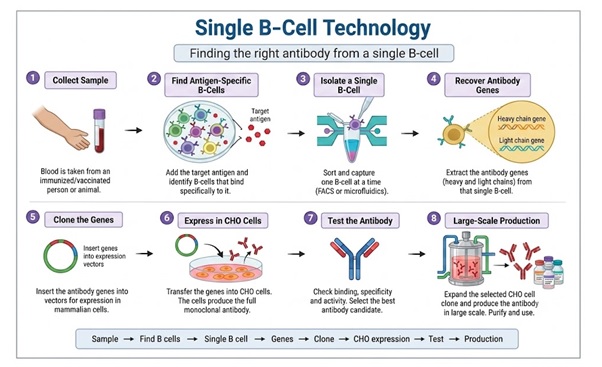
- Obtain Biological Sample: Collect peripheral blood or lymphoid tissue from an immunized animal, vaccinated individual, or convalescent patient rich in active B-cells.
- Identify Antigen-Specific B Cells: Label the target antigen with fluorescent probes to detect and tag the specific B-cells that exhibit strong target recognition.
- Isolate Single B Cells: Use Fluorescence-Activated Cell Sorting (FACS), microfluidics, or droplet-based technologies to isolate and deposit individual B-cells into separate wells.
- Recover Native Antibody Genes: Extract the cellular RNA from each single cell and use RT-PCR to amplify the exact Heavy Chain and Light Chain variable genes, preserving their natural biological pairing.
- Vector Cloning: Insert the recovered heavy and light chain gene sequences into robust mammalian expression vectors.
- Recombinant Expression in CHO Cells: Transfect the vectors into Chinese Hamster Ovary (CHO) host cells to produce fully assembled, intact monoclonal antibodies.
- Functional Bioactivity Testing: Perform high-throughput screening assays to assess the generated antibodies for kinetic binding strength, target specificity, and functional bioactivity.
- Large-Scale Manufacturing: Select the top-performing CHO cell clone for scaling up in bioreactors, followed by downstream validation and purification.
More :