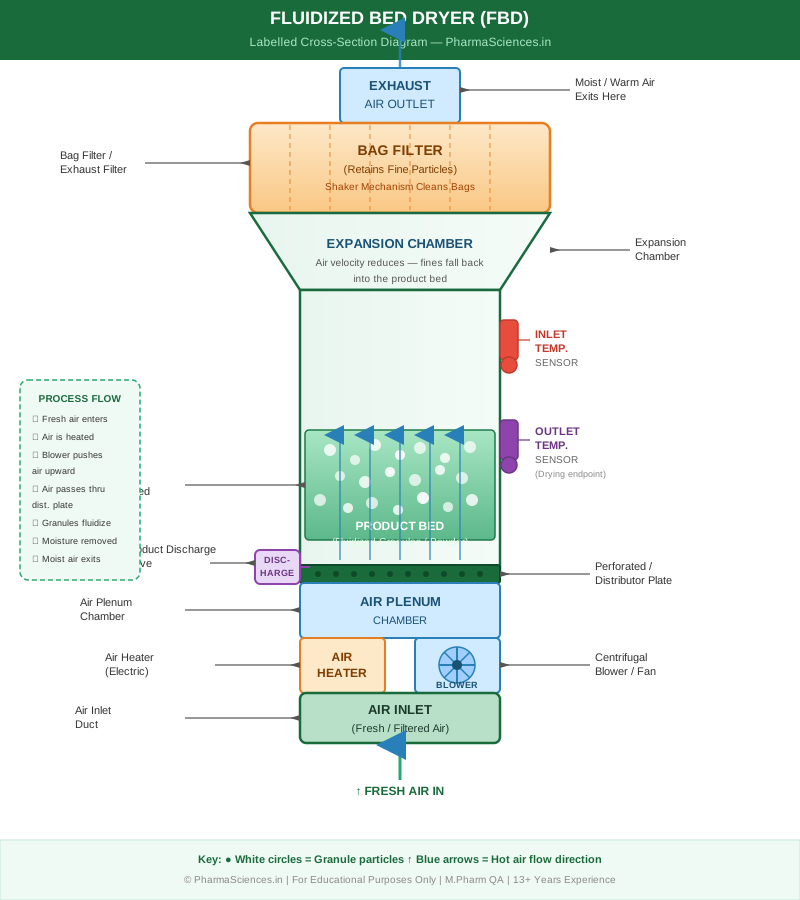
A Fluidized Bed Dryer (FBD), also known as a Fluid Bed Dryer, is one of the most widely used drying equipment in the pharmaceutical industry. It works by passing a controlled stream of heated air through a bed of wet granules or powder, causing the particles to become suspended — or “fluidized” — in the airstream. This creates a dynamic, boiling-like motion that dramatically increases contact between the hot air and every individual particle, resulting in rapid, uniform drying.
FBDs have largely replaced traditional tray dryers in modern pharmaceutical manufacturing because they are faster, more energy-efficient, and produce more consistent results. They are widely used for drying granules after wet granulation, drying APIs, excipients, and other solid dosage form intermediates.
💡 Key Fact: Fluidized Bed Dryers were first introduced into pharmaceutical manufacturing in the 1950s. Today, they are considered essential equipment in any GMP-compliant solid dosage manufacturing facility — from small R&D labs to large-scale commercial production.
The fundamental principle behind an FBD is fluidization — a process in which a solid particulate substance behaves like a fluid when a gas is passed through it at a sufficient velocity.
When air is blown upward through a bed of particles at low velocity, it simply passes through the gaps between particles without disturbing them — this is called a fixed bed. As air velocity increases, a point is reached where the upward drag force on the particles equals the downward gravitational force. At this point, the particles begin to separate and move freely, behaving like a boiling liquid. This critical velocity is called the minimum fluidization velocity (Umf).
In pharmaceutical FBDs, the air velocity is maintained slightly above Umf so that particles are fully suspended, in constant motion, and surrounded by hot air on all sides — achieving maximum heat and mass transfer for efficient drying.
💡 Pro Tip for Interviews: When asked about FBD principle, always mention “minimum fluidization velocity” and explain the three stages: fixed bed → expanded bed → fluidized bed. This shows deep understanding and impresses interviewers.
Every component of an FBD plays a specific and critical role in ensuring efficient, uniform, and GMP-compliant drying. Here is a detailed explanation of each part:
| Component | Function | GMP Consideration |
|---|---|---|
| Blower / Fan | Generates the upward airflow required to fluidize the product bed. Centrifugal blowers are most commonly used. | Must be calibrated for airflow rate. Checked during qualification (IQ/OQ/PQ). |
| Air Heater | Heats the incoming air to the required inlet temperature before it enters the product bowl. | Temperature must be validated. Overheating can degrade thermolabile products. |
| Air Distribution / Distributor Plate | Perforated plate at the bottom of the product bowl. Ensures uniform distribution of hot air across the entire bed cross-section. | Pore size and open area must be consistent. Must be cleaned and inspected regularly to prevent blockage. |
| Product Bowl / Vessel | The detachable container that holds the wet granules or powder to be dried. Made of SS 316L. | Must be cleaned and swabbed as per validated cleaning procedure between batches. |
| Expansion Chamber | Wider upper section of the dryer body. The increased cross-sectional area reduces air velocity, allowing entrained fine particles to settle back into the bed. | Proper height ensures minimal product loss to the bag filters. |
| Bag Filter / Exhaust Filter | Fabric filter bags at the top of the expansion chamber that trap fine particles carried upward by the airstream, preventing product loss and cross-contamination. | Must be checked for integrity before each batch. Shaking mechanism ensures particles fall back. Filter cleaning/replacement per SOP. |
| Exhaust Air Outlet | Allows moist, particle-laden air to exit the system after passing through the bag filters. | Outlet should be directed away from intake. Exhaust humidity monitoring is a key process parameter. |
| Temperature Sensors | Measure both inlet air temperature and outlet (exhaust) air temperature. The outlet temperature rise signals the drying endpoint. | Sensors must be calibrated per schedule. Outlet temperature is used as drying endpoint indicator. |
| Control Panel | Centralized system to monitor and control inlet temperature, airflow rate, drying time, and alarms. | 21 CFR Part 11 compliance required if computerized. Audit trail must be maintained. |
| Discharge Valve | Located at the bottom of the product bowl, allowing dried product to be discharged after the drying cycle. | Must be cleaned after each batch. Avoid contamination during product transfer. |
Understanding the exact sequence of operations in an FBD is critical for both exam preparation and practical GMP compliance. Here is the complete working process:
Wet granules or the material to be dried is loaded into the product bowl (vessel). The bowl is typically weighed before and after loading to confirm the correct batch quantity. The bowl is then attached to the main body of the FBD and sealed.
The blower is started, and the heating system is activated. Ambient air is drawn in, filtered through the pre-filter and HEPA filter (in GMP environments), and then heated to the preset inlet temperature — typically 50°C to 80°C depending on the product.
The heated air passes through the distributor plate and enters the product bowl from the bottom. As air velocity reaches the minimum fluidization velocity, the particles begin to separate, rise, and circulate freely in a boiling-like motion. Every particle is now surrounded by hot air on all sides.
Hot air transfers heat to each particle, evaporating the moisture. The moisture-laden air moves upward through the expansion chamber. Fine particles that get carried up by the airstream are captured by the bag filters and periodically shaken back down into the bed. This cycle continues until the target moisture content is achieved.
The drying endpoint is typically determined by monitoring the outlet air temperature. As drying progresses, less moisture evaporates, so less heat is absorbed by evaporation — the outlet temperature begins to rise. When the outlet temperature approaches the inlet temperature (or a predefined endpoint temperature), drying is considered complete. Loss on Drying (LOD) testing of samples confirms this.
After drying, the heater is switched off but the blower continues to run, allowing cool ambient air to pass through the bed and reduce the product temperature. Once the product is at an acceptable temperature (typically below 40°C), the blower is stopped, the bowl is detached, and the dried product is discharged through the discharge valve.
| Type | Description | Common Use |
|---|---|---|
| Batch FBD | Most common in pharma. Product is loaded, dried, and discharged in discrete batches. | Granule drying in solid dosage manufacturing |
| Continuous FBD | Product is fed continuously. Suitable for large-scale industrial production. | Chemical & food industry, large pharma production |
| Fluid Bed Granulator (FBG) | Combines drying with granulation. Binder solution is sprayed onto fluidized powder to form granules simultaneously. | One-pot granulation process |
| Fluid Bed Coater (FBC) | A spray nozzle coats tablets or granules with a coating solution while they are fluidized. | Modified release coating, taste masking |
| Vibro-Fluidized Bed | Adds mechanical vibration to assist fluidization — useful for cohesive or heavy materials. | Difficult-to-fluidize powders |
In GMP pharmaceutical manufacturing, the following process parameters must be defined, monitored, and controlled throughout every FBD drying cycle:
| Parameter | Typical Range | Impact if Uncontrolled |
|---|---|---|
| Inlet Air Temperature | 50°C – 80°C | Too high → product degradation; Too low → insufficient drying |
| Airflow Rate (m³/hr) | Product specific | Too low → poor fluidization; Too high → product loss through filters |
| Inlet Air Humidity | < 40% RH preferred | High humidity → slower drying; May affect moisture-sensitive APIs |
| Drying Time | 15 – 60 minutes (typical) | Under-drying → microbial risk; Over-drying → brittle granules |
| Outlet Air Temperature | Endpoint indicator | Primary indicator of drying completion — must be monitored continuously |
| Loss on Drying (LOD) | As per product specification | Final moisture content determines product stability and compressibility |
| Product Bowl Load | 40–60% fill capacity | Overfilling → poor fluidization; Underfilling → attrition of granules |
| Parameter | Fluidized Bed Dryer | Tray Dryer |
|---|---|---|
| Drying Time | 15–60 min (fast) | 4–24 hours (slow) |
| Uniformity | Excellent — all particles dried equally | Variable — uneven unless trays rotated |
| Energy Efficiency | Higher | Lower |
| Scale of Operation | Lab to commercial | Lab to commercial |
| GMP Compliance | Easier — closed system | More human handling required |
| Suitable for Sticky Products | No | Yes |
| Capital Cost | Higher | Lower |
| Cleaning | Easier (detachable bowl) | Labour intensive (multiple trays) |
| Granule Attrition Risk | Moderate–High | Low |
In a GMP-regulated pharmaceutical environment, operating an FBD requires strict adherence to documentation, qualification, and procedural requirements. Key GMP considerations include:
Every FBD must be qualified before use in production. This involves Installation Qualification (IQ) — verifying the equipment is installed correctly; Operational Qualification (OQ) — confirming it operates within defined parameters; and Performance Qualification (PQ) — demonstrating it consistently produces product meeting specifications.
The product bowl, distributor plate, bag filters, and all product-contact surfaces must be cleaned between batches as per a validated cleaning procedure. Swab and rinse water samples are tested to confirm no residues exceed defined limits — especially critical when manufacturing multiple products on the same equipment.
Bag filter integrity must be verified before each production batch. A compromised filter bag can result in product loss to the exhaust system and potential cross-contamination of other areas. HEPA filters on the air inlet must also be challenged periodically.
All FBD operations — including loading weight, inlet temperature, airflow settings, drying time, outlet temperature readings, LOD results, and any deviations — must be recorded in the Batch Manufacturing Record (BMR) at the time of performance. Retroactive data entry is a GMP violation.
FBDs are versatile workhorses in pharmaceutical manufacturing. Their primary and secondary applications include:
| Application | Description |
|---|---|
| Granule Drying | Most common use — drying wet granules after high-shear or low-shear granulation before tablet compression |
| Powder Drying | Drying APIs, excipients, and intermediate powders to achieve target moisture content |
| Fluid Bed Granulation | In-situ granulation by spraying binder solution onto a fluidized powder bed (one-pot process) |
| Pellet Coating | Applying functional or aesthetic coatings to pellets in fluid bed coaters |
| Tablet Coating | Aqueous or organic film coating of tablets using bottom-spray fluid bed coaters |
| Microencapsulation | Encapsulating active particles in polymer coatings for modified/controlled release |
| Taste Masking | Coating bitter APIs with polymer layers to improve patient acceptability |
Contact us on : pharmasciences.in@gmail.com
This website uses cookies.